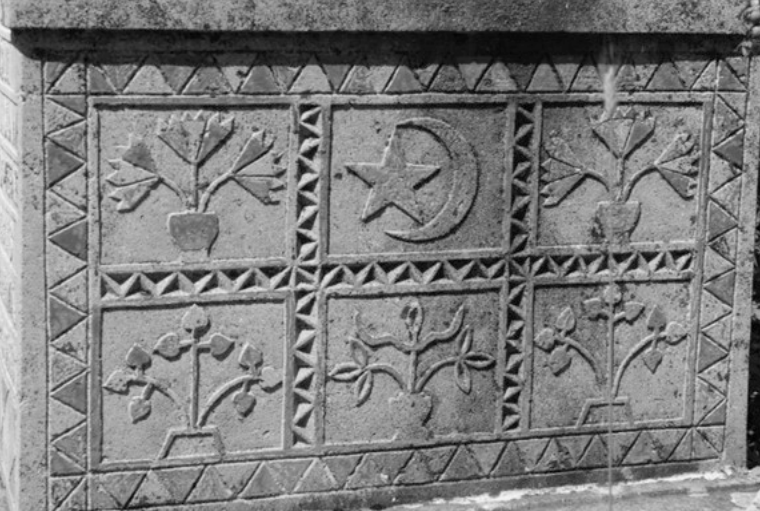
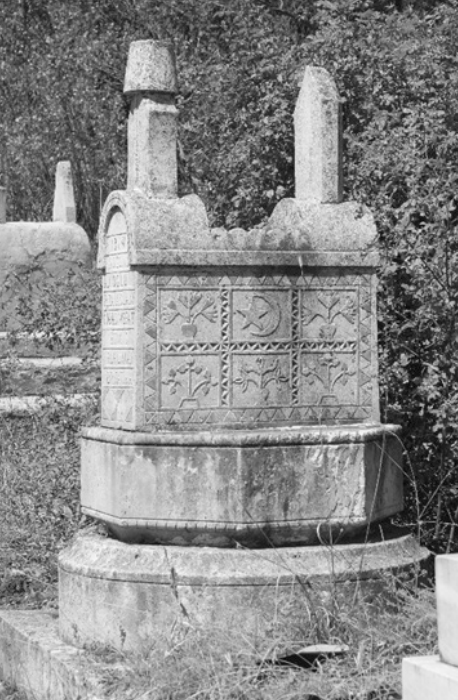
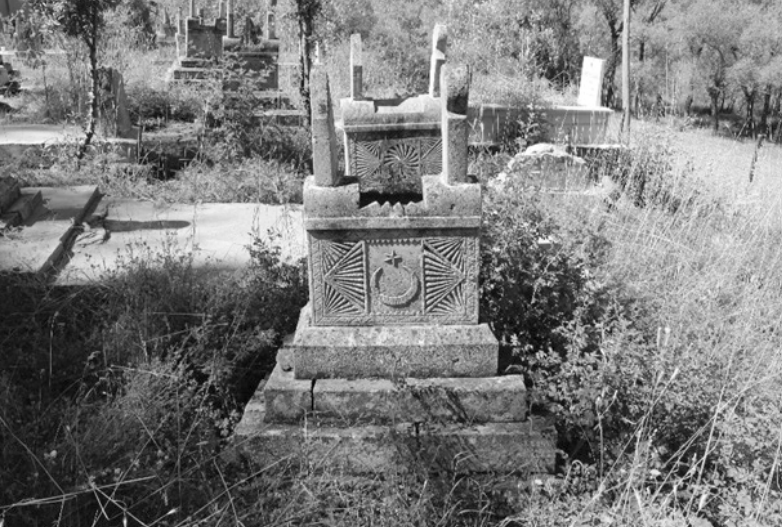
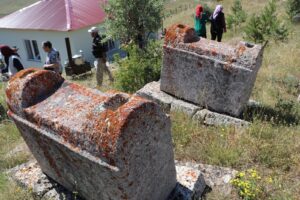
The Bolucan Village Cemetery is located approximately 32 km southeast of the Zara district in Sivas Province. Thirty-five ancient stone tombs have been documented at the cemetery; the tombs consist primarily of pyramid-shaped bases and balbal-like headstones. It is noteworthy that the headstones are oriented toward the east. Motifs depicted on the gravestones include the sun, the moon and stars, flowers, trees, birds, horses, humans, and various objects from daily life and warfare. Most of the graves date to the mid-20th century, particularly the 1940s–1960s; some earlier examples bear inscriptions in Ottoman Turkish. The shapes and decorations of the gravestones are evaluated within the context of ancient Turkic and Anatolian traditions as well as Alevi-Bektaşi cultural elements (Kaya & Uzunöz, 2019).
A very wide repertoire of motifs is seen in the decorations of the gravestones. Among these are:
Sun
, moon, and stars
; flower and plant motifs
; trees
; birds
; horses
; human figures
; houses
; dining tables
; rifles
; swords
; and, in some examples, airplane-like figures. In particular, the six-petaled flower motif is a characteristic decorative element that recurs throughout the cemetery.
Source: Kaya, B., & Uzunöz, C. K. (2019). An examination of the representation of nature motifs in Anatolia through the gravestones of Bolucan Village, Zara, Sivas. Journal of Communication Studies, 5, 163–176. https://dergipark.org.tr/tr/download/article-file/1190128