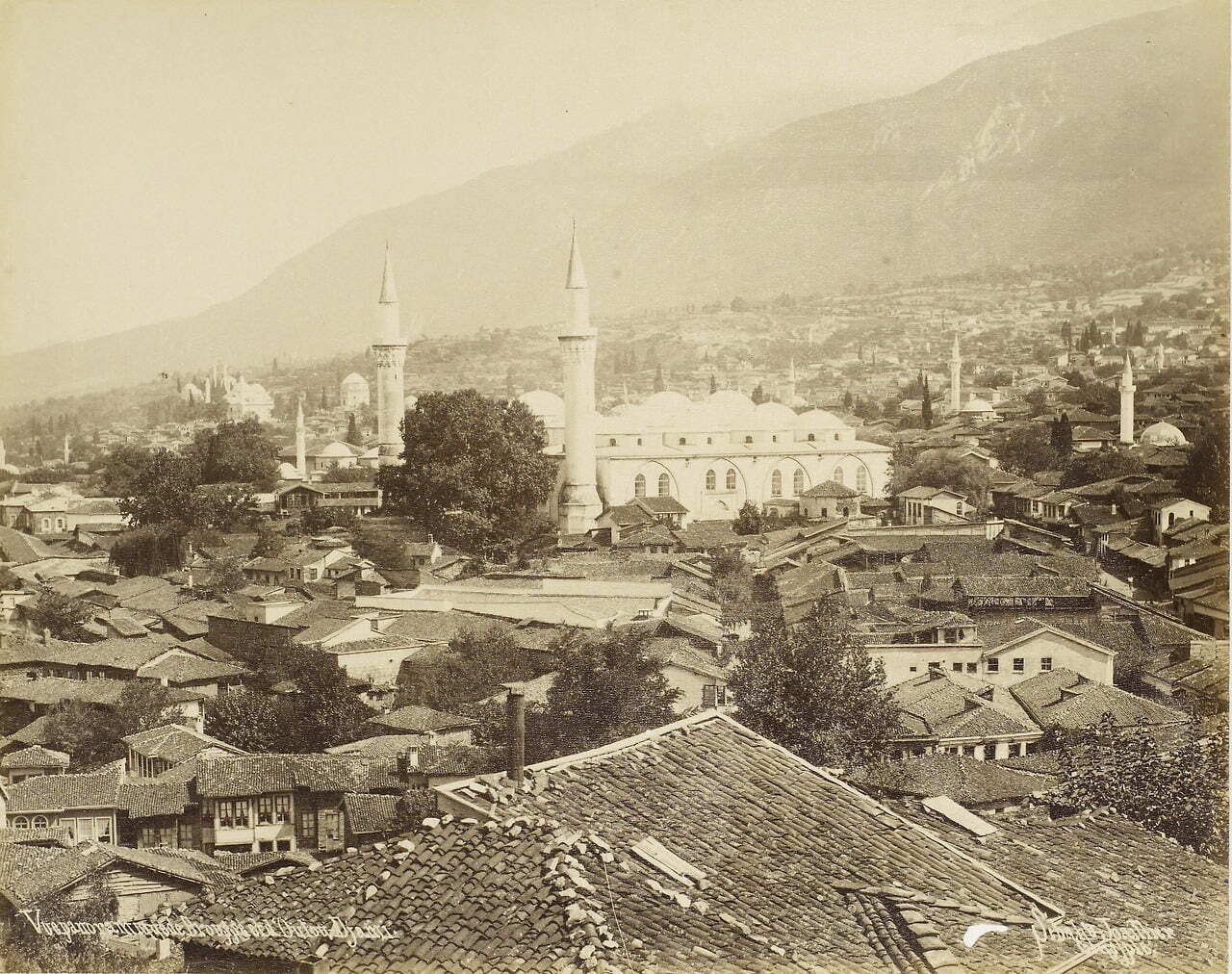
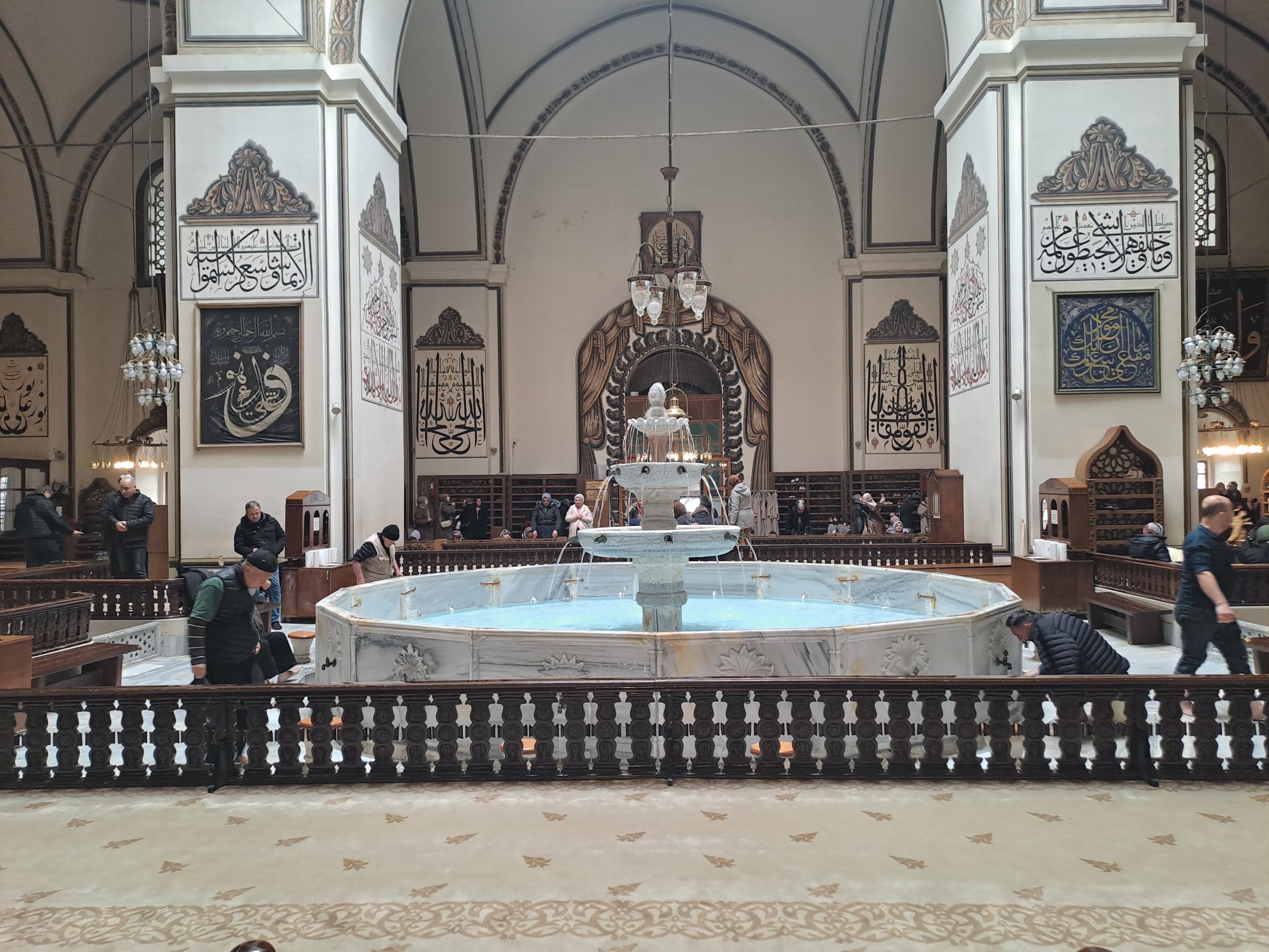
It was commissioned by the Ottoman sultan Yıldırım Bayezid and completed in 1400. The architect is believed to have been Ali Neccar. It is owned by the General Directorate of Foundations.
There is a legend associated with the mosque’s construction. According to the legend, after emerging victorious from the Battle of Nicopolis, Yıldırım Bayezid decided to have twenty mosques built. When he arrived in Bursa, he shared this idea with his son-in-law, Emir Sultan, who advised him to build a single mosque with twenty domes instead of twenty separate mosques. The site of the mosque was also revealed to Emir Sultan through a divine sign in a dream; the following day, grass was seen growing at the indicated spot, thus confirming the location of the mosque. The decision was reported to the Sultan, who approved it and ordered the construction of the mosque to begin. The mosque was built using spoils of war obtained during the Battle of Niğbolu.
Another legend associated with the Ulu Mosque concerns its ablution fountain; it is said that during the mosque’s construction, an elderly woman’s house stood on the site of the fountain, and since she refused to sell it willingly, the state officials, out of respect for Islamic law, did not take it by force. This house was left as it was, open-roofed, provided that it remained outside the prayer area. It is said that after the woman’s death, this area was incorporated into the mosque. The current fountain, located on this previously vacant site, was built in later years by Karaçelebizade Abdulaziz Efendi, who had been exiled from Istanbul to Bursa for political reasons. The traveler Evliya Çelebi noted in the 1640s that trout swam in this beautiful pool, whose water came from Mount Uludağ. The water of this fountain, which springs from a single source at the very top as if to express the oneness of God, flows into the pool from thirty-three separate outlets, as if in praise of God.
The mosque’s first imam-hatib was Süleyman Çelebi, the author of the *Mevlid-i Şerif*. The famous incident that inspired him to write the *Mevlid-i Şerif* took place here. In the month of Ramadan in 1409, the preacher stepped up to the pulpit after the afternoon prayer and, while delivering his sermon and explaining the verse “There is no distinction among the Messengers…” (Al-Baqarah 285), a member of the congregation objected, saying, “Even if there is no difference among them in terms of prophethood, my prophet, the Prophet Muhammad (peace be upon him), is superior to all of them in terms of virtue.” This issue became a topic of debate. Süleyman Çelebi, who witnessed this exchange, decided right then and there to write his *Mevlid-i Şerif*, which recounts the virtues of the Prophet. The *Mevlid-i Şerif* is written in Turkish and consists of approximately one thousand couplets.
The black cloth hung in a slightly elevated position on the right side of the pulpit is the covering of the Kaaba’s door. Yavuz Sultan Selim, who became caliph after the Egyptian Campaign, undertook repairs in Mecca and, in the process, replaced the Kaaba’s covering with a new one sent from Istanbul. Yavuz had the old covering brought to Bursa and presented it as a gift to the Ulu Mosque, carrying and hanging it there with his own hands. This covering, on which verses from the Quran were embroidered with pure gold thread, remained undimmed for centuries; however, due to moisture in the mosque resulting from some botched restorations, the embroidery has flaked off, so today the verses can only be seen under bright light.
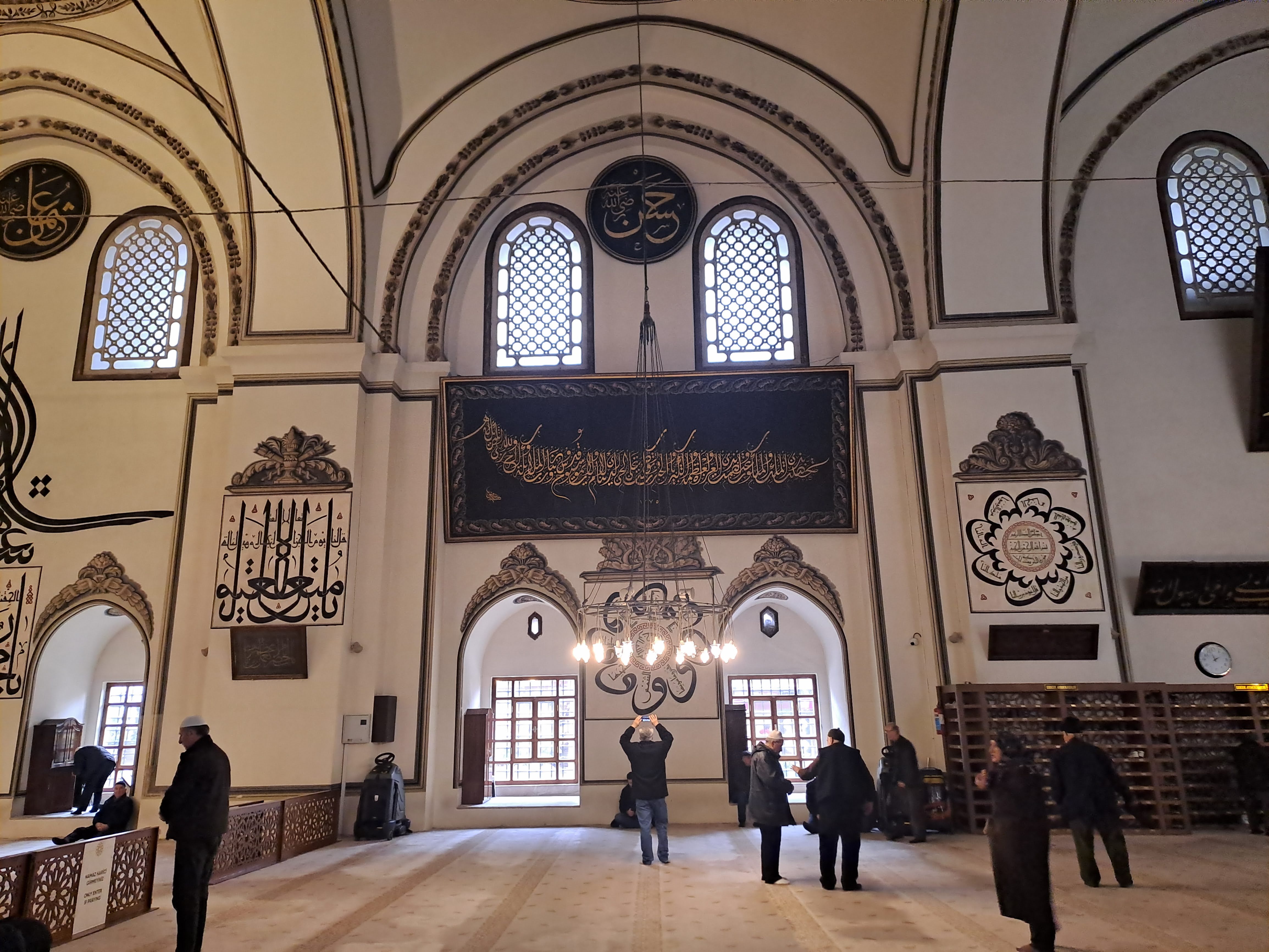
The Ulu Mosque, a unique structure in Ottoman architecture in terms of its construction style, is a rectangular building measuring 55.00 x 69.00 meters. Its total interior area is 3,165.5 m². It is the largest of the mosques in Turkey bearing the name “Ulu Cami.” The wall where the mihrab is located is larger than the other walls. The mosque is covered by twenty domes supported by twelve piers, and the dome at the center is open at the top. In recent years, this opening has been covered with glass. The walls are built entirely of neatly cut stone.
Timur, who defeated Yıldırım Bayezid in the Battle of Ankara, came to Bursa with his armies and destroyed the mosque by setting fire to its northern gate. It was also set on fire by Karamanoğlu Mehmet Bey, who piled wood around it. In the 1855 earthquake, eighteen of the mosque’s domes collapsed; only the dome at the base of the western minaret and the dome in front of the mihrab remained standing. In a fire that broke out in 1889, the wooden spires of the minarets burned down and were subsequently rebuilt in masonry. During the restoration work carried out between 1959 and 1961, the plastered walls were stripped, and the northern gate was rebuilt in accordance with its original design. Major repairs were carried out in 1494, 1503, 1551, 1563, 1567, 1572, 1668, 1670, 1724, 1742, 1815, 1855, and 1861, the mosque underwent major repairs and acquired its current appearance.
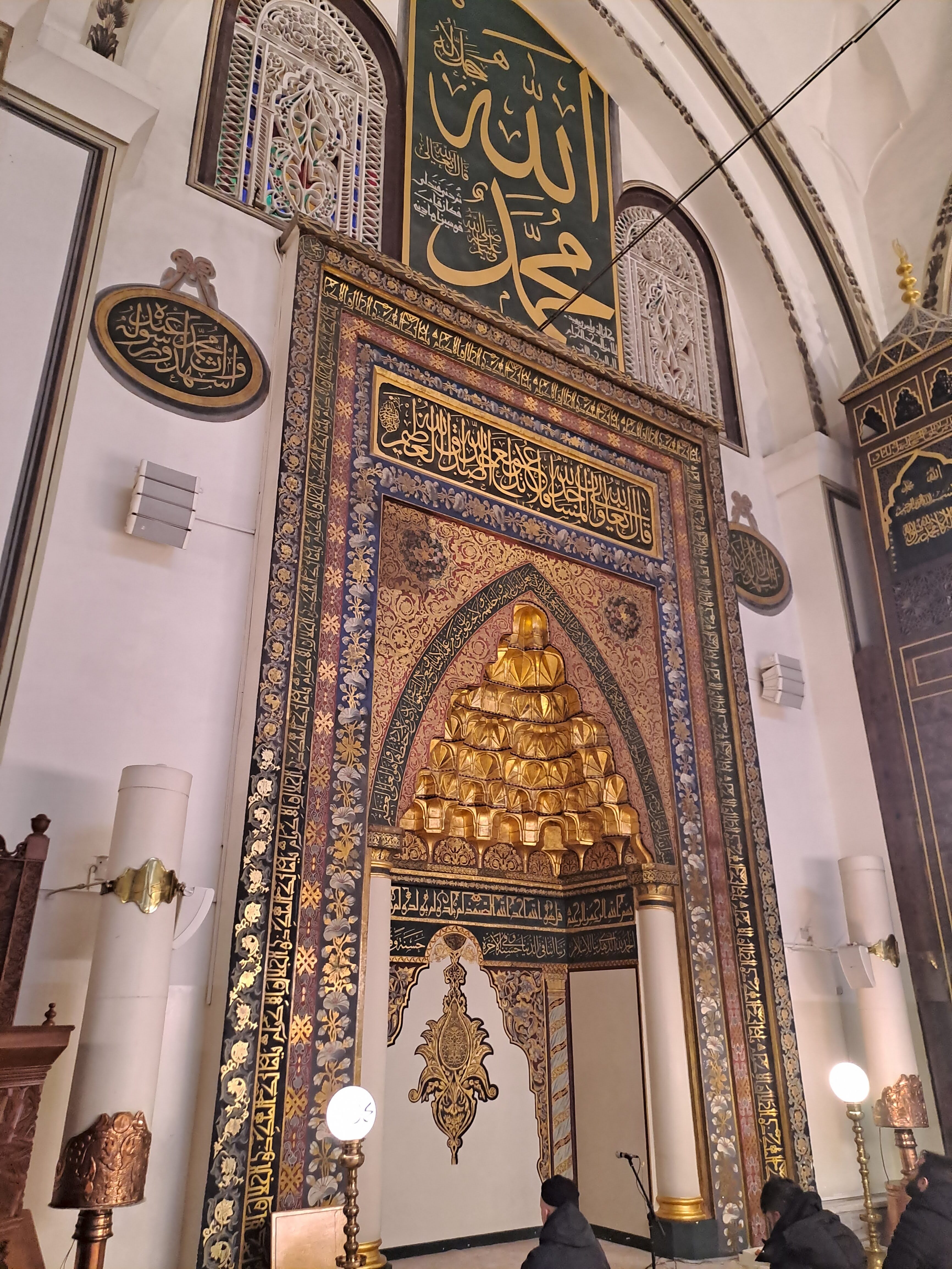
The mihrab, which features eight rows of stalactites bearing traces of the 14th century and is adorned with hourglass-shaped columns at the outer corners, was completed in 1751. The name of the master craftsman, Mehmet, who built the mihrab, is inscribed on its left side. The minbar, made of walnut wood and painted black, is the mosque’s most beautiful and artistically crafted piece—a rare work of art. An inscription measuring 0.40 x 1.00 meters above the door states that it was completed in 802 H. (1400) by order of Yıldırım Bayezid. The minbar is the work of Hacı Mehmet b. Abdülaziz el Dukki of Antep, who also crafted the minbar of the Ulu Mosque in Saruhanlı, Manisa, dated 1379. The inscription providing this information is written vertically on the minbar’s right balustrade. It was crafted using the Künkedari technique. It is a work created by interlocking pieces carved in geometric patterns, without the use of glue or nails. The eastern face features several protrusions, which are said to represent the solar system and the planets. With its intricate carvings, this minbar is a masterpiece illustrating the transition from the Seljuk to the Ottoman style.
The tall and simple muezzin’s pulpit, resting on eight elegant columns, was built in 1549. The round, single-piece marble pulpit, carved from a single block and mounted on a pedestal opposite the pulpit, was built in 1815. The mosque has three doors facing east, west, and north. The northern and western doors are newer, while the eastern door’s wooden panels were constructed during the same period as the mosque itself. The wooden panels are made of walnut. Although some parts have deteriorated, it has survived intact to the present day. The doors, adorned with carved and interlaced geometric motifs, bear the characteristic features of the 16th century, in keeping with the mosque’s minbar. The appearance of the main entrance, which opens onto the northern courtyard, further enhances the monument’s grandeur. Its arch consists of eleven rows of stalactites, and a wide, simple molding encircles the glossy niche.
The mosque’s windows vary in shape and size on each facade, and their jambs are made of plain marble. The window lintels feature small openings known as “nefeslik.” A lower row of windows on the south wall has been closed off at a later date. The upper row of windows is not aligned on the same axis as the lower row. The wall thicknesses vary. The east wall is 2.80 meters thick, the west wall is 3.10 meters thick, the north wall is 2.40 meters thick, and the south wall is 2.20 meters thick.
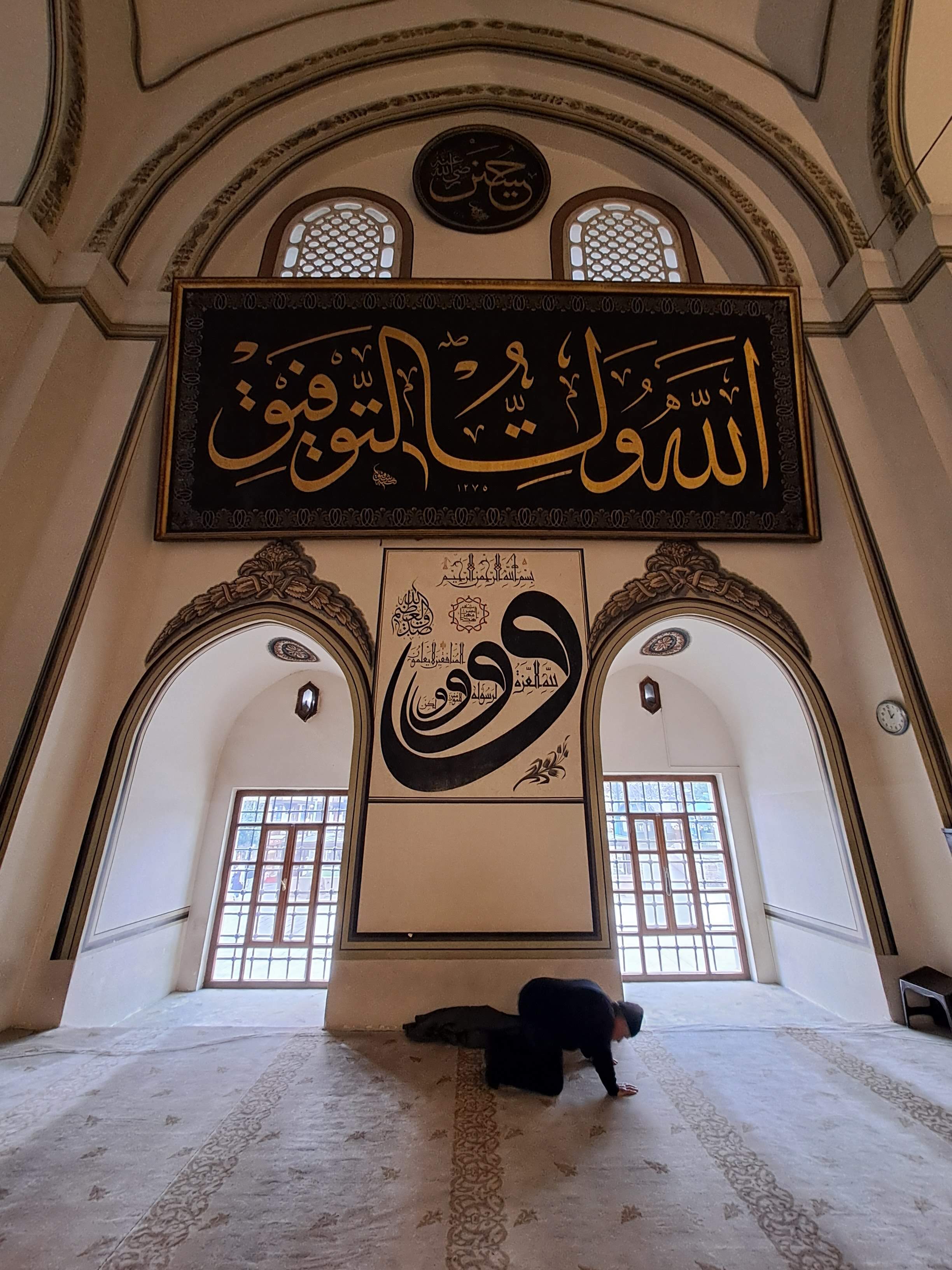
Most of the plaques decorating the interior walls of the Ulu Mosque bear the calligrapher’s signature. The majority of the missing portions have been corrected or rewritten by Calligrapher Şefik Bey. Inside the mosque, there are 192 inscriptions in total: 87 written directly on the walls and 105 on panels, created by 41 different calligraphers using 13 distinct calligraphic styles. Additionally, the mosque houses highly valuable clocks, candelabras, and copies of the Quran.
The mosque has two minarets at its eastern and western corners. The minaret on the western side was commissioned by Yıldırım Bayezid. The base of the minaret, which is adjacent to the mosque, is made entirely of marble, while its shaft is clad in brick. There are two paths leading up to this minaret—one from the outside and one from the inside. One leads to the domes, and the other to the balcony. The balconies are identical on both minarets and are adorned with six rows of brick stalactites. There are three ablution fountains in the mosque courtyard. It is believed that the ablution fountain inside the mosque was designed in the early years of the Ottoman Empire, reflecting the Turks’ interest in water. The sixteen-sided basin is filled with water flowing in eight streams from a three-bowl fountain and distributed to the spouts. The axis of the mihrab and the axes of all three doors converge at the center of the ablution fountain.
*Source: Bursa Governor’s Office