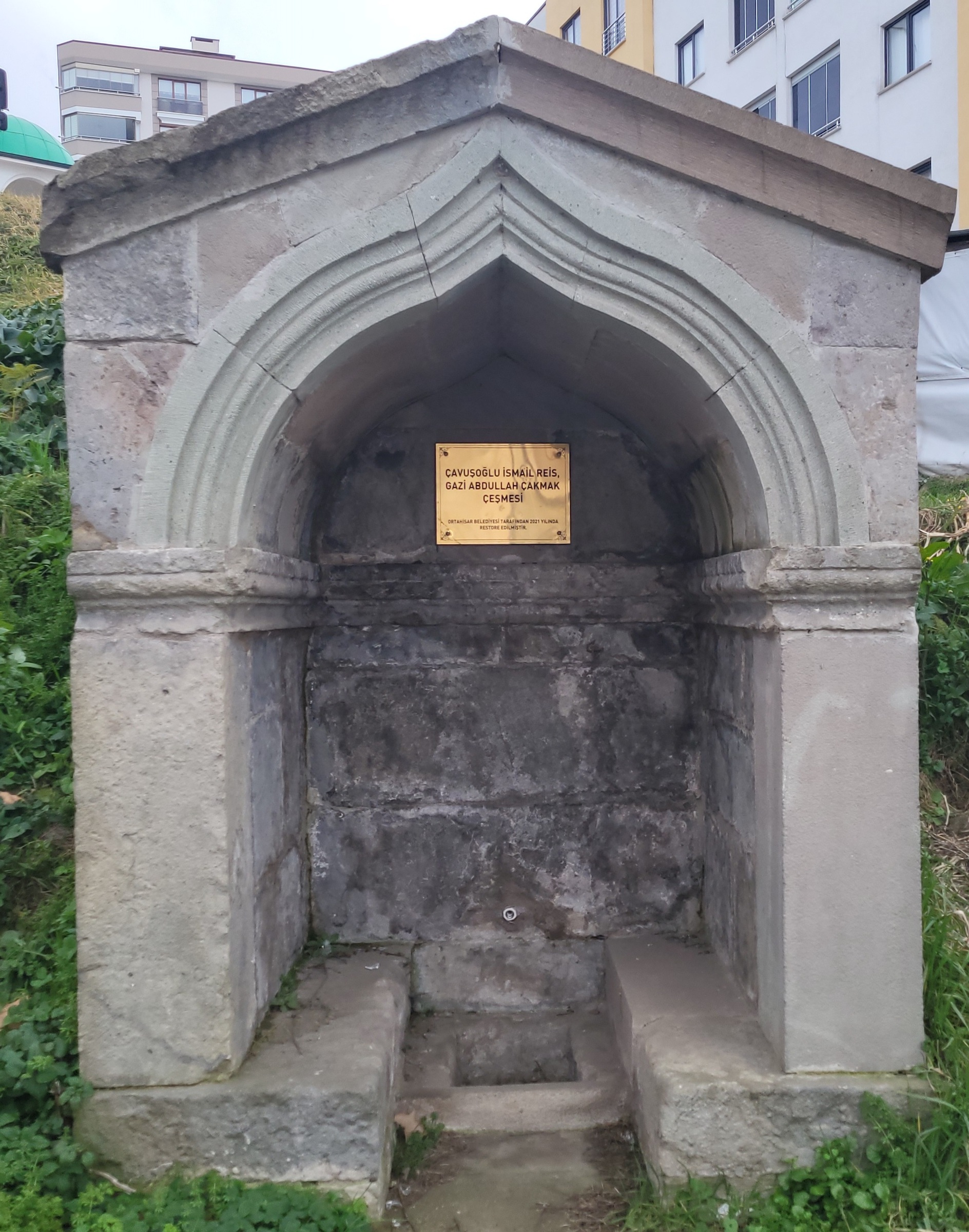
The Çavuşoğlu İsmail Reis Fountain was built in 1929. Constructed entirely of cut stone, this structure belongs to the group of fountains featuring a water reservoir, arches, a water basin, a single spout, and an iwan. Built as a traveler’s fountain in a rural area, the fountain also features an iwan that serves as a shelter for travelers during rainy weather.
The fountain measures 1.40 x 1.85 meters and is covered by a gable roof. A profiled molding separating the body from the arched section wraps around the interior of the structure, adding movement to the façade. The keystone arch, resting on thick piers, forms both the fountain’s front facade and the pediment of the gable roof. At the lower level of the iwan’s side walls, seating benches extend the full depth of the structure. These benches serve both as a functional resting area and as an element that completes the structure’s spatial integrity.
The water basin has been completely lost, and its base has been damaged. The inscription above the fountain is arranged in a square format measuring 0.25 x 0.25 meters at the center of the keystone arch. The inscription, carved into the marble using the engraving method, has become illegible over time due to erosion. From the remaining traces, it is understood that the inscription contained a four-line text framed by three ruled lines and written in the thuluth script.
Due to a lack of maintenance over time, the inscription panel of the fountain has been largely destroyed, and part of the arch’s lintel has collapsed. Although the structure’s general form and stonework are partially preserved today, the water basin and inscription are on the verge of disappearing.